 Henry Brean Arizona Daily Star
Some of those observations were made using the Dark Energy Spectroscopic Instrument — DESI for short — mounted to Kitt Peak’s Mayall 4-meter Telescope.

A full moon rises behind the Nicholas U. Mayall 4-meter Telescope at Kitt Peak National Observatory. The telescope is home to the Dark Energy Spectroscopic Instrument, or DESI, which was used earlier this year in the rare observation of a supernova explosion.
DESI can capture the light from scores of galaxies at once using an array of 5,000 fibers pointed at the night sky and connected to 10 spectrographs packed into a room below the Mayall Telescope’s main floor.
When some of the instrument’s fibers are not already matched to objects in space, they can be used to track transient astronomical events picked up by NOIRLab’s new Vera C. Rubin Observatory in Chile, an $800 million telescope that is in the second year of a constant, decade-long scan of the night sky as part of the Legacy Survey of Space and Time.

An image captured by the Vera C. Rubin Observatory in Chile in 2025 shows the field around the progenitor to supernova SN 2026gzf, which appears as a bright blue dot within the galaxy located in the middle of the upper third of the photo before its catastrophic explosion first detected by astronomers on March 21 of this year.
“DESI’s spare-fiber program gave us the opportunity to return to SN 2026gzf repeatedly and follow how its spectrum changed as the explosion evolved,” said Xander Hall, a graduate student at Carnegie Mellon University and one of the co-authors of the new paper. “This sequence of observations demonstrates the power of using DESI’s spare fibers for rapid transient follow-up and classification as Rubin continues to ramp up its transient alert stream over the next decade.”
Researchers believe the type of dying star at the center of the supernova had already undergone a series of mass ejections before its final collapse, shedding its hydrogen and helium into shells surrounding it.
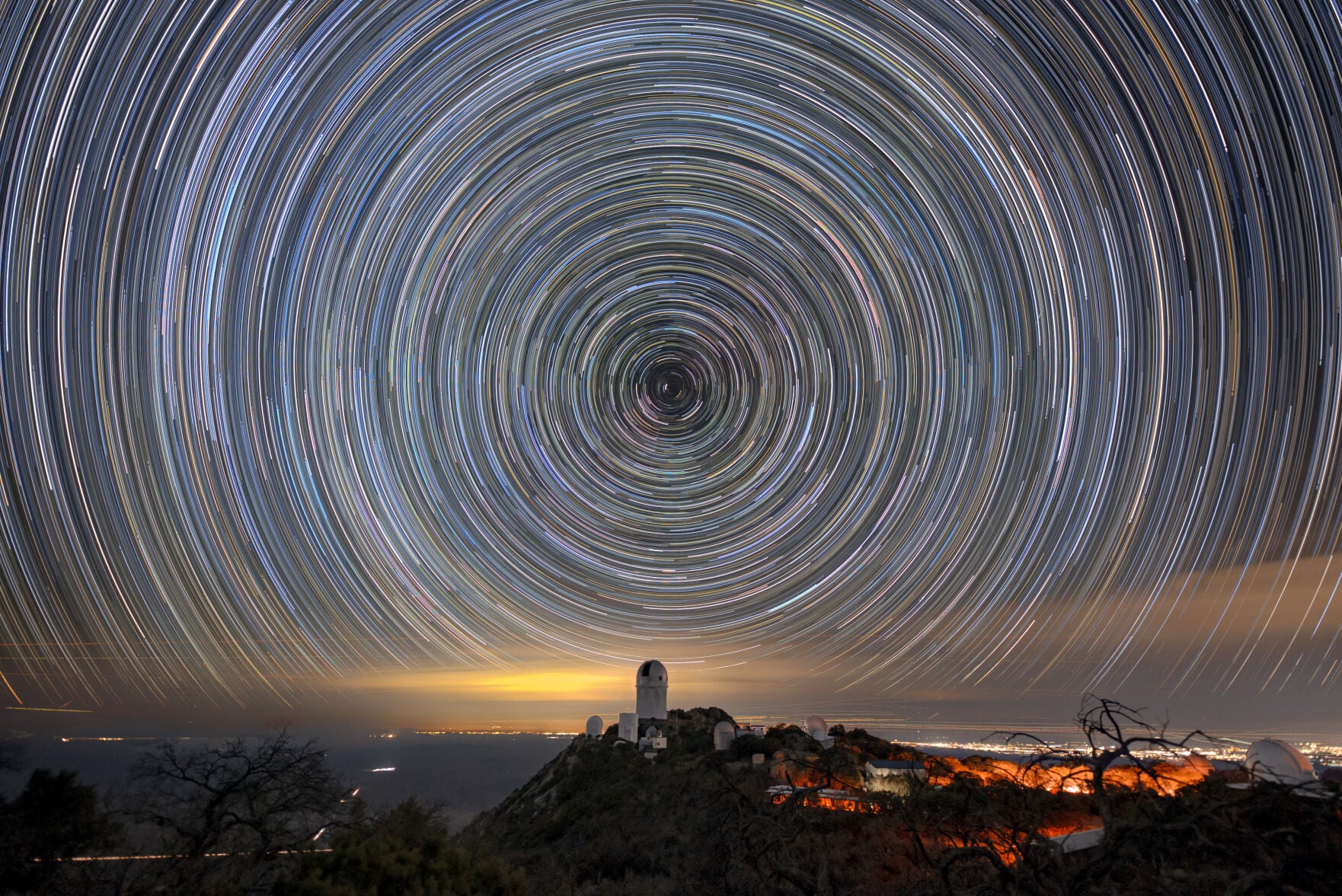
A trail of stars swirls above the Nicholas U. Mayall 4-meter Telescope at Kitt Peak National Observatory in a time lapse photo. The telescope is home to the Dark Energy Spectroscopic Instrument, or DESI, which was used earlier this year in the rare observation of a supernova explosion.
“This is the first time we’ve mapped out the pre-explosion environment of a star that has been stripped of hydrogen and helium,” said co-author Gokul Srinivasaragavan, a recent PhD graduate from the University of Maryland and a member of Rastinejad’s team. “Going forward, I’m excited to observe more shock breakout events in similar detail to test if all stripped stars have a similar ‘lifestyle’ prior to collapse and what, if any, differences we see.”
Source link
Henry Brean Arizona Daily Star Researchers see star explode with help of Tucson-area scope tucson.com
tucson.com – Arizona Local News Results in news/local of type article 2026-08-05 15:00:00
+



GIPHY App Key not set. Please check settings